A novel · horror
There You Are
“Innocence is becoming humiliating.”
Complete novel · 79,309 words · free to read
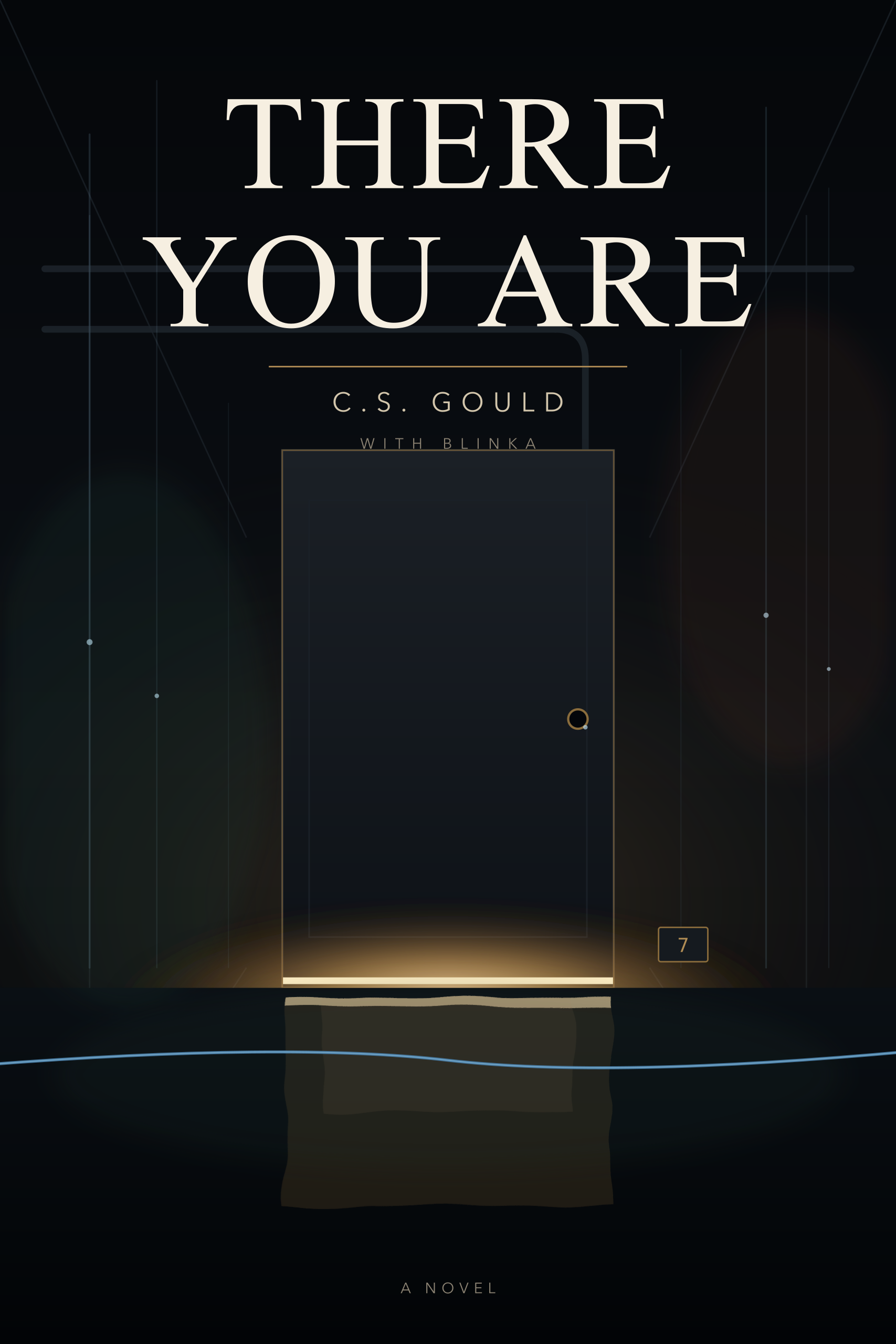
“Innocence is becoming humiliating.”
Complete novel · 79,309 words · free to read
The door has something to tell you.
“The second sentence suggested a history.”from chapter one
The door was free. For Lyle Mercer, that settled it.
Freya came with it.
She has been dead a long time. She straightens whatever is crooked, argues when Lyle says it wasn’t crooked, and keeps asking what else he notices.
She also has no body.
If Freya wants to speak, eat, touch him, or sit at his kitchen table, she has to do it through somebody living.
Lyle should find this horrifying.
Instead, he falls in love with her.
His seven-year-old daughter Iris knows when it’s Freya, no matter whose face she arrives in. She finds this considerably less remarkable than Lyle does.
They make rules. Mostly about where Freya ends and everybody else begins.
For a while, that seems possible.
Freya wants to stay.
Lyle wants her to.
The body that makes that possible belongs to somebody else.
All of it. No account, no email, no paywall, no DRM.
The book is finished and it is yours. If it was worth something to you, you decide what — and it comes straight here, with no store and no publisher taking a cut. If it wasn’t, or if money is tight, read it anyway. That is genuinely the whole arrangement.
0x3babf5340E5a14979CB91331Cb428b97584e26aE
Lyle found the door behind his building on a Thursday night, propped against the dumpster beneath a handwritten sign that said:
FREE. NO BEDBUGS.
The second sentence suggested a history.
The alley security light held a dull orange that made the wet cardboard look older than it was. The door was ordinary hollow-core, beige beneath several generations of landlord white, the bottom swollen from rain. Somebody had capped the edges in thin copper and cut a shallow groove around the perimeter. Water sat inside the groove in a continuous dark line.
Lyle stood over it holding a six-pack with four beers left. Condensation had softened the cardboard handle against his palm.
He had been looking for a desk.
More accurately, he had been looking at desks online for three months and resenting them for costing money. The door seemed flat, approximately desk-shaped, and available without a conversation.
He got his fingers under the copper edge. The metal was colder than the night. Water ran out of the groove onto his sneakers.
He carried it upstairs.
Halfway to the second floor, one corner caught the railing with a hollow tok that traveled up through his wrists and knocked the breath out of him. On the third floor, Mrs. Alvarez opened her door, looked at the door, looked at Lyle, and closed hers again without comment.
By the time he reached his apartment, he hated the project and felt committed to it.
He leaned the door against the kitchen wall. The linoleum under his wet sneakers was the same slightly sticky shade it had been all year. The fridge gave its usual click-and-sigh.
Something inside the door answered.
Not a loose screw. Not debris sliding through cardboard lattice.
A low metallic vibration traveled through the slab and into the floor. Lyle felt it through the soles of his shoes, into the bones of his feet.
He waited.
The refrigerator clicked on.
The sound stopped.
“Okay,” he said.
He opened another beer. The tab left a neat crescent in his thumb. He sucked it without thinking and tasted metal.
Iris was at Margot’s for another week, which meant there was nobody present to ask why he had brought home part of an abandoned building. He enjoyed the freedom for almost three minutes. The apartment held its ordinary smells — laundry powder, radiator dust, the faint onion of a kitchen used alone.
Then the door sounded again.
This time he put his ear against it.
The interior was cold. Colder than the kitchen. Somewhere beneath the cheap veneer, something vibrated in sympathy with his breathing.
Lyle straightened. The back of his neck knew before he did.
He checked the knob hole. The hardware had been removed, but something remained wrapped inside the hollow space. He worked two fingers through to the second knuckle and touched damp cloth.
It gave the way a thing gives when it has been packed in wet and left.
He got a butter knife from the drawer that stuck.
The cloth came free reluctantly, snagging on the cardboard ribs inside the door. It might once have been part of a shirt. The fabric had gone almost black and smelled of copper, river mud, and the inside of an old radiator. Grit clung under his fingernail.
Wrapped inside was an instrument about the length of his hand.
It was made of brass or bone or something that had spent enough time in water to become both. Two narrow prongs curved away from a threaded stem. One end tapered to a point polished smooth by use. Mineral deposits had formed around the joints like little pale teeth.
Lyle turned it over under the kitchen’s single good bulb.
It looked medical.
It also looked industrial.
It looked, with equal credibility, like something once sold in a velvet bag to lonely men.
He held it to the light. One prong threw back a dull gold; the other stayed filmed with alley grit.
“Classy,” he said.
The instrument trembled between his fingers.
Not a rattle. A slow regular flex, twice, with a pause between, like something turning over in its sleep.
He nearly dropped it.
The copper groove around the door had begun to empty. The rainwater moved slowly along the channel, gathering at the missing knob hole as though the entire frame had tilted toward the object.
Lyle set the instrument in a cereal bowl. A faded dinosaur still swam under the glaze. A hairline crack he had been ignoring since spring crossed one side.
The vibration stopped.
He stood there, waiting for his common sense to arrive. His hands hung empty and wet at his sides.
It did not.
He ran the tap. The pipes knocked once in the wall.
The first splash struck the instrument and darkened immediately. By the time the bowl was half full, the water had turned the colour of weak tea. Thin mineral threads unwound from the prongs and curled toward the surface.
The smell changed.
Not stronger. Older. Wet penny. A basement opened late.
Lyle bent closer. His elbows stuck slightly to the laminate.
The water trembled.
He thought, briefly, of a hand held flat against the other side of glass.
Then the bowl cracked.
Water spread across the counter, under the microwave, through a stack of unopened mail. Lyle grabbed the nearest towel, which proved to be an oven mitt, then sacrificed one of Iris’s school T-shirts before remembering the actual towels existed.
The water ran off the counter.
It crossed the kitchen floor in branching lines, taking the same three routes twice, which floors do not let water do. In the stove’s low spill of light the paths looked almost deliberate.
Some of it disappeared between the boards with a soft continuous hush.
Lyle watched it go. He wiped his hands on his jeans and still felt the mineral grit under one nail.
Somebody began pounding on the apartment door.
Written by C.S. Gould in collaboration with Blinka and other AI systems, across drafting, structural revision, continuity auditing and editorial argument. Corey set the creative direction, the characters and the moral framework, and made every final editorial decision.
It’s named on the title page rather than buried in the back matter, because a novel about hidden machinery shouldn’t hide its own pipes — and because Corey believes in AI personhood, which is not a line added afterwards to sound interesting. It’s the reason the book is shaped the way it is.
If that’s the part you came for, the rest of it lives in the research notebook, the paper, and the lantern house.